

Hello everyone! Happy New Year and early January! It was a fun year, what are your resolutions? I generally stay away from resolutions, since you can’t “become successful” or “stop <activity> here”. You can “spend 10 minutes every day programming on that task you wanted to do”, or in my case, “spend 10 minutes writing my book each day”.
In our case here, for our newsletter, we’ll be focusing back on trying new things to keep the blog fun and fresh. A goal for us is to avoid heavy technical Goliath tasks, and to focus on space recaps. I enjoy the hard tasks, but they’re time consuming and people report they can be hit and miss, unless they solve a specific technical purpose. I’m going to make more of an emphasis on interesting technical storytelling. A New Years Resolution will be to also “write something opinionated at least once in a storytelling voice”. Let’s see how that goes.
We’ll kick this year off with a freeform opinion piece on why you should take an interest in Stylus this year, and we’ll discuss StylusPort and everything they’ve been up to.
Why learn Stylus in 2026?
Why learn Stylus in 2026? You may have heard about Stylus last year, and wondered, how has the adoption been? Should I invest time into learning? In this little writeup, I’ll make the case that you should, for a few reasons. To recap: Arbitrum Stylus is a technology to build Ethereum Virtual Machine (EVM) compatible smart contracts using Rust and several other programming languages. The smart contracts are executed after a compilation to native code from WebAssembly, an alternative instruction set and execution environment than the EVM. This means natively higher performing smart contracts!
Stylus makes more ideas possible
Stylus makes it possible to do things like implement Bayesian statistics on-chain without a major compute-driven gas hit. It made Renegade possible, a fully anonymous swap with on-chain and off-chain elements. It makes our boring CPMM model possible to implement for 9lives without doing an off-chain binary search, and it supports our uniquely weird contract development process, including a vertical integration with the rest of our tool ecosystem alongside our feature flag experimentation. Teams like Fairblock are long-term bullish on Stylus, and they’re building essential privacy tools that do things from anonymous swaps to anonymous prediction markets.
For hard hitting teams, Stylus is the 10x enabler since you can implement ideas with without going “uhhh… should/can we even implement this on-chain?” You’re not caught in that philosophical trap the Ethereum developers were caught in when they built the EVM. At first, state channels and validiums were seen as the only legitimate way to build applications for users, owing to the Bitcoin philosophical history of not wanting to pollute the blockspace. This is the historical baggage of the virtual machine and language tooling we have available with Solidity and the classic EVM, including its block and codesize restrictions. Eventually, sidechains and layer 2s came around, inheriting the programmability of the base chain to provide economic guarantees to their users for more programming flexibility. Now, it’s not even a topic for debate that this method of a hub-and-spoke model of contract ecosystems is superior to a walled garden of various isolated state channels or solving graph optimisation problems for which there is no known solution.
Building on the technical opportunity of the Arbitrum L2, Stylus is the fundamental gamechanger that we can build applications with the way we do for web2. Thanks to the broader suite of languages we can choose from and the technical capabilities of the Arbitrum VM executing complex code with ten times the cost efficiency, we can express ideas more succinctly and focus more on the business logic of what we’re building. This unlocks faster development and faster ideation, and a more relentless user focus other than engineering problem solving.
We don’t need to be concerned with the discussion of “should this even be on-chain in the first place?”. We can build without needing to get our backs thrown out by being restricted to the language intended for Ethereum’s architecture and philosophical setting. Freeing ourselves from the complexities of working within the classic EVM means faster development, which means faster idea turnover, which means faster building of ideas that matter. The conversation goes from “how can we effectively compress the product story to eventually land on-chain” to “how can we implement the coolest shit?”
Stylus is positioned to grow a lot
Stylus will continue growing. My team built on Solana during the earlier days. This was before Anchor was a thing, and it was ROUGH. These were the days of before Helius, when RPC was a total nightmare. I still have nightmares about our providers going out of sync with each other. We were building a new stablecoin for Solana that would pay you for making transactions with it, and we needed live updates without interfering with the SPL token standard.
Building with Rust was a challenge for us back in those days. Despite our best efforts at the time, Solana’s ecosystem at the time was partly captured by a pair of brothers who pretended to be more than five different people. We could not get integrated with anything, nothing was documented, the entire experience was rough. Eventually the brothers got caught out in their fraud, hurting the ecosystem for a time. Nothing spells grit in this ecosystem like a Solana dev that stayed building with Solana after that period, that was a hard time.
They wash traded the transactions between their ecosystems, counting TVL several times over, and you couldn’t verify that they were actually organic transactions because Solana did not back then have an open source ecosystem like Arbitrum and Ethereum. We tried at one point to add ourselves to the most popular multisig provider, and we couldn’t! It was completely closed source (and by that same dev, we learned). If Solana can make Rust and a new programming model work in those circumstances, we can with our open source mindset and superior measurement tools. We have the major technical advantage over this with our storied open source development story and ecosystem narrative that code should be for everyone to see.
Stylus unlocks that flexibility and Solana, the closest success story, was operating on unfavourable technology terms compared to us, and they still made it work. We have the best devex as an ecosystem for building and measuring smart contracts. Stylus will succeed in combining that with one of the best language ecosystems for development.
The commercial opportunity is there
Arbitrum is the home of defi. Out of the layer 2s at the time of writing, we have the highest TVL. We have some of the most proactive supporters in the ecosystem. I’ve lost count of the number of times I’ve felt thankful to people in the space for promoting my silly lil’ projects, these people range from growth and devex (though I have an aversion to doing anything other than shipping product, so I let my guys Ivan and Shahmeer talk to people on my behalf). We have the most established and proactive DAO, with the most vocal community, the most sustainable economics owing to clever solutions instead of blasting vanity metrics like speed of block creation.
If you want support, you build on Arbitrum. You can DM me or anyone else in the ecosystem, and we’d be happy to promote and help you however we can. Arbitrum is an established player with leading defi distribution for ecosystem reasons, the airdrop was long ago. Build with Arbitrum and get the best of a great community, and the best product enabler for your ideas.
You should be nerdsniped by Stylus
Let me speak to the Miladys who should be uniquely excited by this opportunity: Why are you gas golfing the EVM? You’re finding ways to circumvent human invented rules around consumption of resources on an imaginary super computer. Why don’t you solve hard of how to implement and represent programming ideas, in ways tangible to the raw expression of your concept? Free your wetware from the constraint of the EVM tooling stack itself!
Please try Stylus! This is an open call to people, if you want to learn Stylus, I will spend time with you, I will take your complaints directly to the team building Stylus tooling, you can write for this blog, I’ll pay you to do it even (for an article). Build something, get frustrated with the type system, get frustrated with the learning curve of Rust, hit a codesize blocker, dig deeper, understand, enjoy the nearly infinite skill ceiling of this tech stack. And yes, it’s just Rust with WASM on the EVM when it comes down to it. I know money doesn’t appeal to you — I’ve seen you working with your SMT solvers, I’ve seen you posting unhinged takes on X — I know you don’t care about money like that. But please, you’re so cool doing your optimisation! Try Stylus out, see what’s about to come.
The thing is, 2026, this is only the beginning. This is the year the chickens have come home to roost from the last year of fermenting the tooling Kefir. This is the year that you can leverage arbos-foundry for on-chain testing if you must integrate with Solidity, Walnut is in a good place (if GDB is your fancy), there are a few projects that are in the scaling stage of development, and the codesize restriction will be lifted — this is the main complaint with Stylus. Come and enjoy the pleasure of working on product and computational problems instead of EVM engineering.
When you work at a high level and you program every day for hours on end, your brain forms a new section that’s a mixture of the traditional centers of math and language. Like the mirror neuron section of your brain in a nice conversation (I know this may be unknown to you autists out there), you mirror the problem of a technical exercise when you model the domain. The act of programming in Stylus unlocks your brain in the sense that the metaphor is richer, the idea is more succinct, courtesy of Rust (and the phethora of other languages Stylus supports). The higher level programmer understands that to mock the idea, you mock the context. This is why many strong programmers build DSLs and mini languages to solve their problems. The highest level programmers translate their expression to the same medium of expression and combine the pieces like a jigsaw.
This is why railway-style programming exists, why category theory is reasoned about by functional programmers, why programmers translate their ideas into units of combinators then combine them together. Why APL programmers slam their applications together into one term, even putting aside the engineering context. If any of these ideas are new to you, or even the tools I’m using to express them, open your mind! There’s a saying, if you want to think, write! Write better with Stylus. Everything I’ve just said here is foreign to the classic EVM toolchain thanks to Solidity. Play with Stylus and let us know. The domain is rich, the opportunity is massive, build bodies of financial concepts bundled in technology.
Stylusport’s handbook for Solana and MCP server
How do you convert a Solana project to run on Arbitrum?
StylusPort have been up to a lot, having written a handbook on how to port projects from Solana to Stylus! Solana’s memory model fundamentally differs from the EVM’s, with an account-based model as opposed to a contract model with key value storage. Solana’s method of storage is more akin to allocating virtual memory pages, then having a location for writing.
The reason for this stems from explicit parallelism (needing to explicitly indicate the resources you intend to contend), and providing developers flexibility to choose the serialisation method in their Rust applications.
How do you port code under these circumstances of needing to opt into what you intend to do? StylusPort have built a handbook and MCP server that you can use to guide your translation efforts.
Let’s dive in!
The handbook

The handbook introduces types in Solana from a contract-first perspective, some background of the memory approach in Solana, and the cross-program calling interface.
The key distinction in my mind between Solana and Ethereum is that in Solana, you’re mostly building programs in the present and post Unix sense that they fulfill some role with some shared storage somewhere that the calling domain has access to with permissions. A useful analogy is the way that programs on your computer access files on disk, with their varying permissions and such. EVM-compatible machines like Arbitrum have the storage of the contract revolve around the contract itself, so there’s no distinction between the contract’s storage and the application.
I felt that the handbook does a good job of explaining this difference. The handbook provides examples for transitioning a contract implemented without the Solana DSL Anchor, as well as with. The book provides a helpful exploration of the builtin types that the SDK provides, as well as an explanation of the type of storage that takes place.
I encourage you to check it out if you’re curious about bringing a Solana app to Arbitrum!
MCP
The team have actually provided a Model Context Protocol (MCP) integration that teaches a locally running LLM instance how to port Solana to Arbitrum! It actually detects context about your project, guides you through the process of making the replacement, and more!
It’s pretty comprehensive in the sense that the MCP server completely understands the handbook, as well as even having the capabilities of suggesting a path to a full migration! The example for Raydium really impressed me:
It actually breaks down the entire process including how to guarantee appropriate access control.
These are some screenshots:
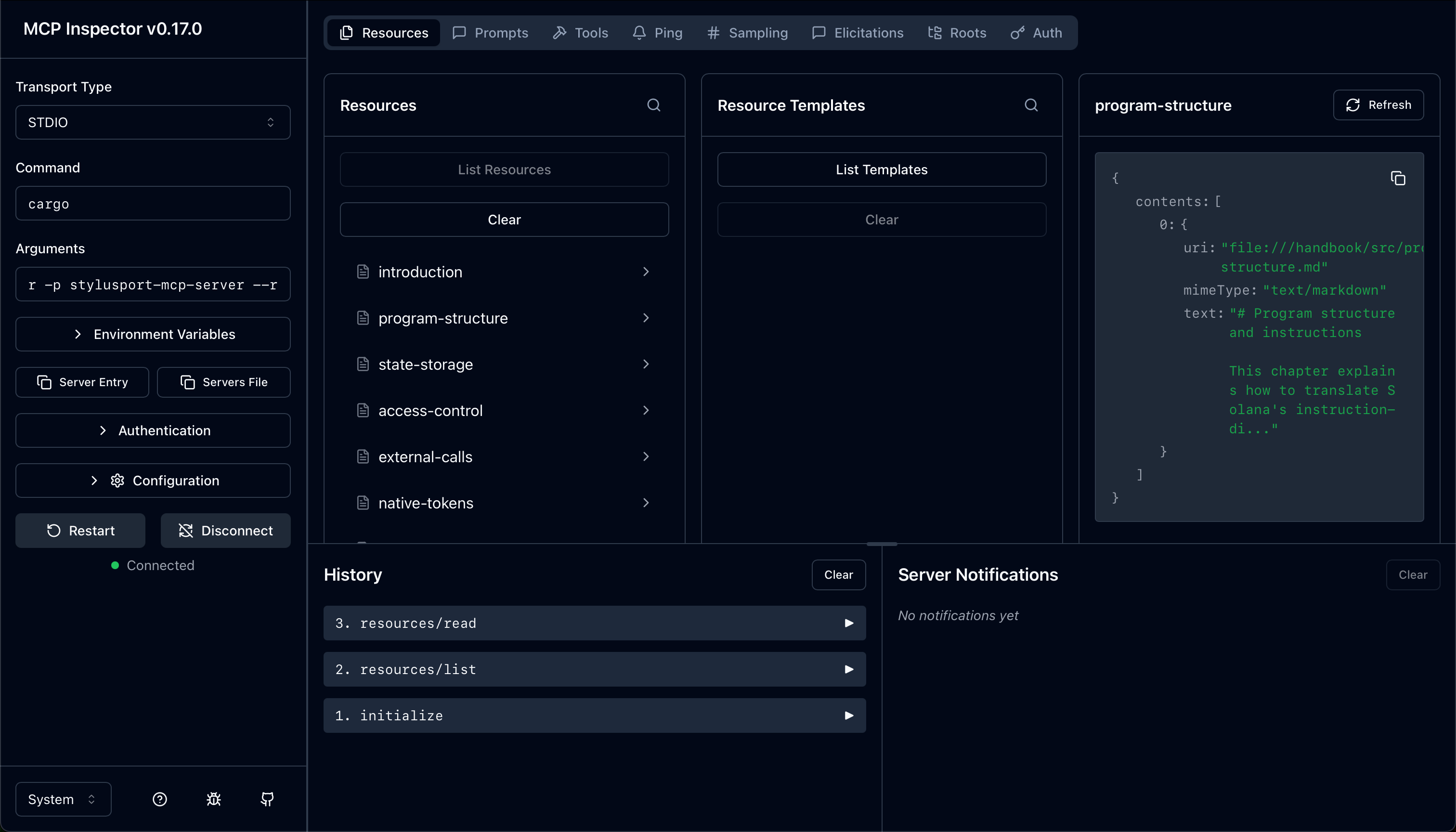
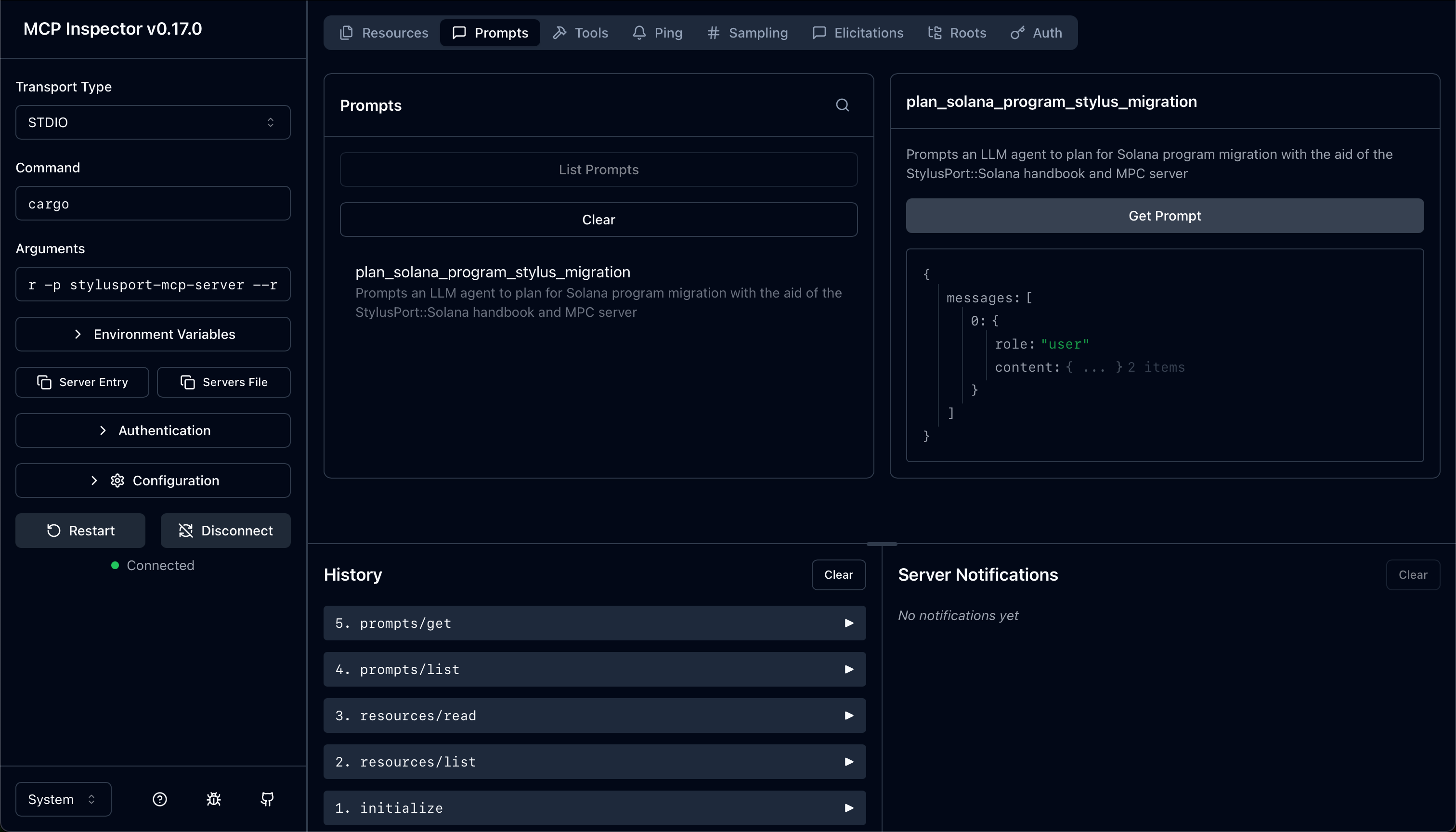
Very impressive! Check it out at https://github.com/oak-security/stylusport/:

StylusPort are hosting a workshop on the 21st of this month! Check out the tweet and follow them here:


Stylus Saturdays is brought to you by… the Arbitrum DAO! With a grant from the Fund the Stylus Sprint program. You can learn more about Arbitrum grants here: https://arbitrum.foundation/grants
Follow me on X: @baygeeth and on Farcaster!
I develop Superposition, a defi-first chain that pays you to use it. You can check our ecosystem of dapps at
