

Hello everyone! I hope you’re well, it’s insane to think that we’re approaching the end of the year almost.
Stylus changes that were in Pectra
Arbitrum has seen another major update for the Pectra release. At the time, a contract reactivation was needed, which I hope you were able to manage yourself comfortably. There are few things that should be kept in mind:
Any multivalue return statements are no longer going to work on-chain. Apparently no-one was making use of this, so there should be nothing that’s needed to keep in mind to keep your existing contracts compatible with the chain. But to prevent yourself from using it in the future, go to
.cargo/config.tomland set these compiler flags (or set it yourself with Rustc somehow). This will prevent Rust from emitting code this way:
[target.wasm32-unknown-unknown]
rustflags = [
  "-C", "target-feature=-multivalue"
]
The contract size limit is going up in a big way! We went from 76kb to 96kb, a huge (and very welcome!) improvement.
The stylus-sdk has seen several improvements for quality of life and testing.
All in all, a very welcome change for us all! Thank you to everyone that made that happen.
Arbitrum Open House
The Arbitrum Open House in Asia is happening, with an online component: https://arbitrum-singapore.hackquest.io/buildathons/Arbitrum-Open-House-Singapore-Online-Buildathon
Which may lead to an IRL component in Singapore:
https://openhouse.arbitrum.io/
If you win in the online component, there’s a guaranteed placement in the IRL stage.
With this thread, you can learn more:

I’m entering!
9lives Rfqhub and rich types
9lives is a prediction market that specialises now in 0-day options trading that we relaunched on Arbitrum. These are options that expire in a short timeframe, and they’re the fastest growing category in prediction markets (apart from sports predictions). When we started 9lives, we wanted a permissionless venue for people to make prediction markets themselves. We didn’t have success in this, and we dropped the focus on the permissionless markets.
We’ve been building a technology that lets users backstop liquidity on our venue from other platforms. We see the market for short-term markets growing, and we believe there’s scalability with our historically model-centric approach. The model is simple: a RFQ engine matches you when you want to source liquidity using a pool of underwriters, who can get their liquidity from other sources.
If we don’t have the liquidity for your market in the model, we send your request it to a network of competing solvers who may get it from an on-chain swap at the time. You don’t know how their position against you was structured, but the smart contract guarantees that it was there for you.
Thanks to Stylus, the app is entirely free to use, as it doesn’t even interact on-chain until you withdraw, or the solver wants to get their liquidity from the platform. The app is a validium without general compute like Superposition Passport. It works like a validium in the sense that you need to offramp using our centralised service, and it’s not general in that we don’t support a general compute model, instead only our typed recursive application.
Making sure it actually works we find is one of the core strengths of Stylus:
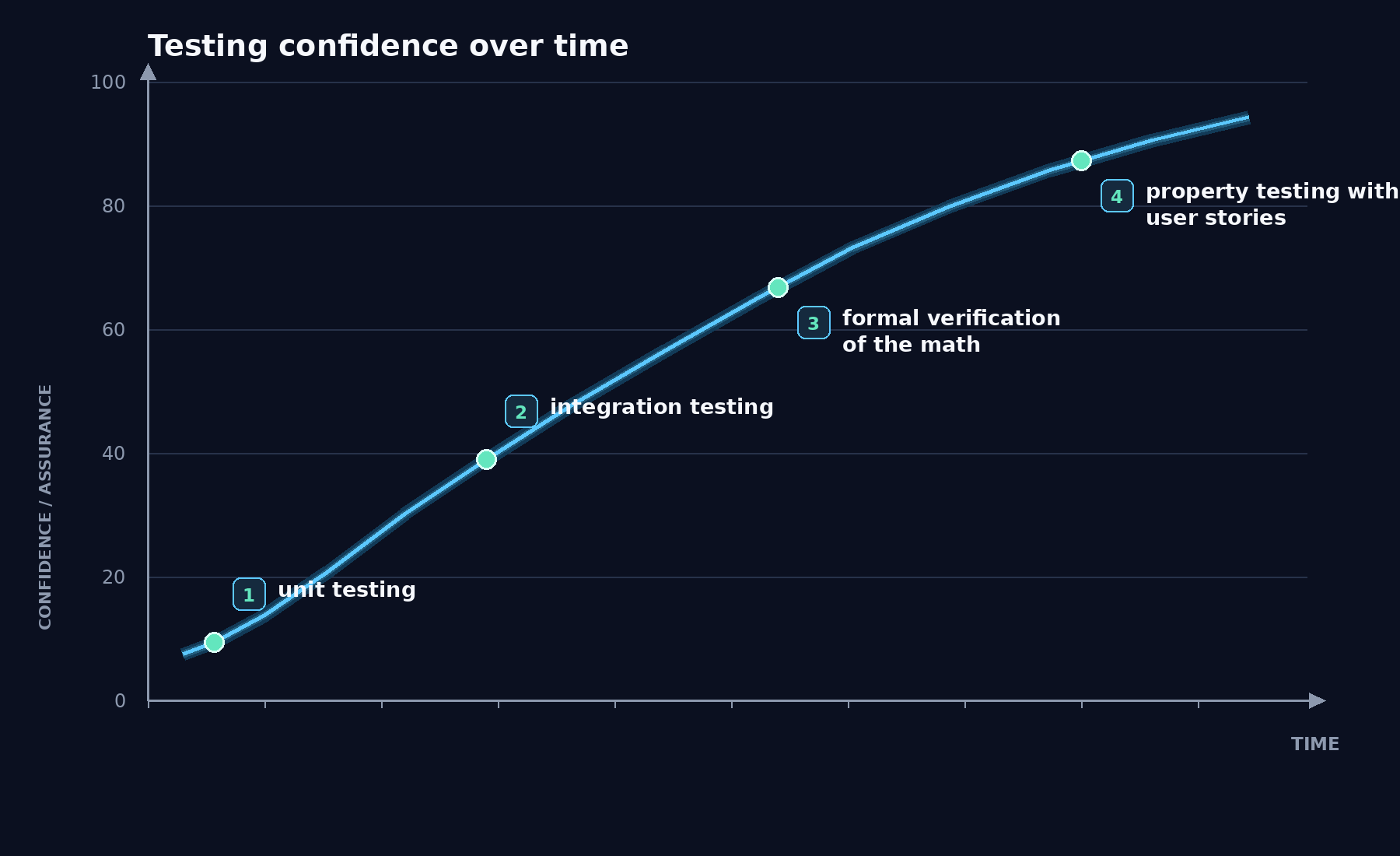
Yes, I did AI generate this image. We’ve been able to create a simplified high level view of the actions users can take with the product then use property testing to derive the application as a recursive structure, then test it.
Over the last few months, we’ve been experimenting internally with models to find the best fit for this system. To this end of aggregating liquidity from different sources in a RFQ context, we wrote a paper. The focus is on Hyperliquid to understand the market economics in play of the liquidation engine, and we found by way of testing using the RFQ model with the architecture of Orderbookkit that it’s possible to solve almost $40 million for their users. It really shows how a RFQ system can improve the mechanics of a CLOB. We posted about it here:

We find that the RFQ space will be evolving, hopefully with Rfqhub in the drivers seat, as developers develop new approaches for batching auctions. Stylus we feel is a powerful technological enabler of this, in that you can perform discrete computations on-chain.
An approach for batching auctions we’re excited about are combinatorial auctions. A combinatorial auction is a type of atomic sale of multiple assets, where either asset is sold, or nothing happens. Some of the leading solvers are implemented using machine learning, and the leading company for combinatorial auctions works with index funds and ETFs to rebalance portfolios. The benefit is the atomic execution of the purchasing of a basket of assets that are not correlated.
We’ve felt that it wasn’t possible to correctly build a solver like this owing to the execution environment in the past on-chain, but we’re going to try with the Stylus world at some point. Somehow using predictions in the mix, since they’re very likely not correlated, the biggest issue with combining multiple assets into a single sale. Maybe 9lives will see some interaction with this at a future date. Rfqhub will be open sourced in the future.
Some contract helpers we made
We deployed several contracts on Arbitrum One that we think are helpful. You can find the deployment addresses here at https://github.com/fluidity-money/superposition-precompiles. They are all usable from bobcat-precompiles easily. These are:
Ed25519ph verifier
This contract verifies any ed25619 data that it’s given. Ed25519 is a signature scheme that’s used by Bitcoin and Solana, and we find it performs cheaply and is easy to understand.
Muldiv helper
A simple muldiv helper when super precise fee efficiency is needed.
Sha512
A prerequisite for the ep25519ph verifier, we need to create a hash that’s compatible with the expectation of the main signature system.
Checked root using ruint
A checked root approximation helper contract.
XZ decompressor
Decompress XZ. Why make this? We don’t know.
I hope this comes in handy for someone out there.
Stylus Saturdays is brought to you by… the Arbitrum DAO! With an original grant from the Fund the Stylus Sprint program. You can learn more about Arbitrum grants here: https://arbitrum.foundation/grants. Check me out online: https://bayge.xyz
I develop Superposition, a product house of different apps, the main focus being 9lives. You can check our ecosystem of dapps at https://superposition.so.